Updates on the work, the research, and where the next chapter is taking me.
October 2026News
The book is happening. And the film is out.
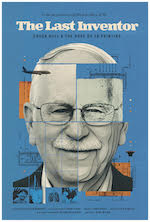
I wrote back in June that I might be in a documentary. I can stop saying "might."
Last week, Ray Marchant, the Executive Producer of The Last Inventor: Chuck Hull & The Hope of 3D Printing, reached out to ask for permission to include my story in a companion book written alongside the film. Ray is the one who interviewed me at Free 3D Hands during the shoot last summer. We gave our permission right away.
The book is by Wayne Drash. The chapter on Free 3D Hands includes a section about me, covering how I got started, the internship in Australia, and a few things I said on camera during the interview.
The film is now in the festival circuit. There is a screening at the Newport Beach Film Festival this Saturday, October 17, and a Hollywood premiere on November 10, on the 43rd anniversary of the night Chuck Hull first cracked stereolithography. Ray mentioned they are also working toward distribution, so it should be available more broadly eventually. When I know more I will post it here.
I wrote in the June entry about meeting Chuck Hull at Free 3D Hands and not knowing whether anything I said on camera would end up in the film. Now my name is in the book too. I am still taking it in.
I was accepted to Senator Mayer's Youth Advisory Council
I applied to Senator Shelley B. Mayer's Youth Advisory Council earlier this summer, and I found out this week that I was accepted.
The YAC is a group of students from across New York's 37th Senate District who work with Senator Mayer's office on civic issues, community initiatives, and policy. Senator Mayer chairs the Senate Education Committee, and the council draws students from schools across Westchester. Last year's group traveled to Albany to tour the Capitol, observe the Legislature in session, and present their own policy proposals directly to legislative staff. That is the part I keep thinking about. Not just visiting, but actually putting proposals in front of people who can act on them.
Everything I have worked on over the last few years, the prosthetics, the stormwater research, the class president work, has been about trying to solve real problems for real people. YAC feels like an extension of that, but at a scale I have not worked at before. I am also looking forward to meeting students from across the district who are thinking about the same kinds of questions from completely different angles.
The first meeting is September 4th in White Plains. I will write more here once the year is underway.
July 24–31, 2026Research
Alberta week 1: the other way to build
I want to start by saying this clearly: I owe this week to Dr. Mohamed Al-Hussein. He is a professor of Construction Engineering and Management at the University of Alberta, and he did not have to open his lab to a high school student from New York. I am grateful in a way I am still working out how to express.
The trip did not begin the way we expected. There was an error in the invitation letter the university had sent, and when we arrived at the Canadian border, a customs officer initially denied entry. After reviewing the circumstances, the officer allowed us in as visitors for five days. The next morning we met with the university to ask whether the stay could be extended. It could not. Five days was what we had.
Dr. Al-Hussein went above and beyond to make those five days count.
The lab's focus is offsite, modular construction: the idea of moving as much of the building process as possible into a controlled factory setting, where quality can be tightly managed and conditions are predictable, before components are shipped and assembled on site. Coming directly from LSU, where I had spent four weeks watching a robot print concrete in place on the actual ground it would occupy, the contrast was immediate. At LSU the question was: how do you bring automation to where the building will stand? At the University of Alberta the question is almost the opposite: how do you take construction off site entirely, into a building, so it can be done better? These are two different visions for modernizing the same industry, and I found myself thinking about that from the first day.
On the first day of the visit I was paired with Yasmeen, an undergraduate civil engineering student entering her senior year, who walked me through the group's labs and offices in the NREF building as a guest observer. The first stop was a team meeting already underway when we arrived: about eight researchers, a mix of graduate and undergraduate students and postdocs, reviewing their workflow and a program called Revit. Prof. Al-Hussein told me directly that Revit is the single most important software used by civil engineers and that he wanted me to understand it before I left.
Revit is a BIM tool, which stands for Building Information Modeling. In a conventional drawing, a line is just a line. In Revit, a wall is a wall: it knows its own material, volume, and every component it is built from. Change one beam height, and every floor plan and elevation in the entire model updates automatically. The team showed me a full building model and demonstrated selecting a wall to see exactly what it is made of, in full detail. That level of specificity is what lets a manufacturer know precisely what to produce, and a site engineer know precisely what to build. A direct line from design to fabrication to construction.
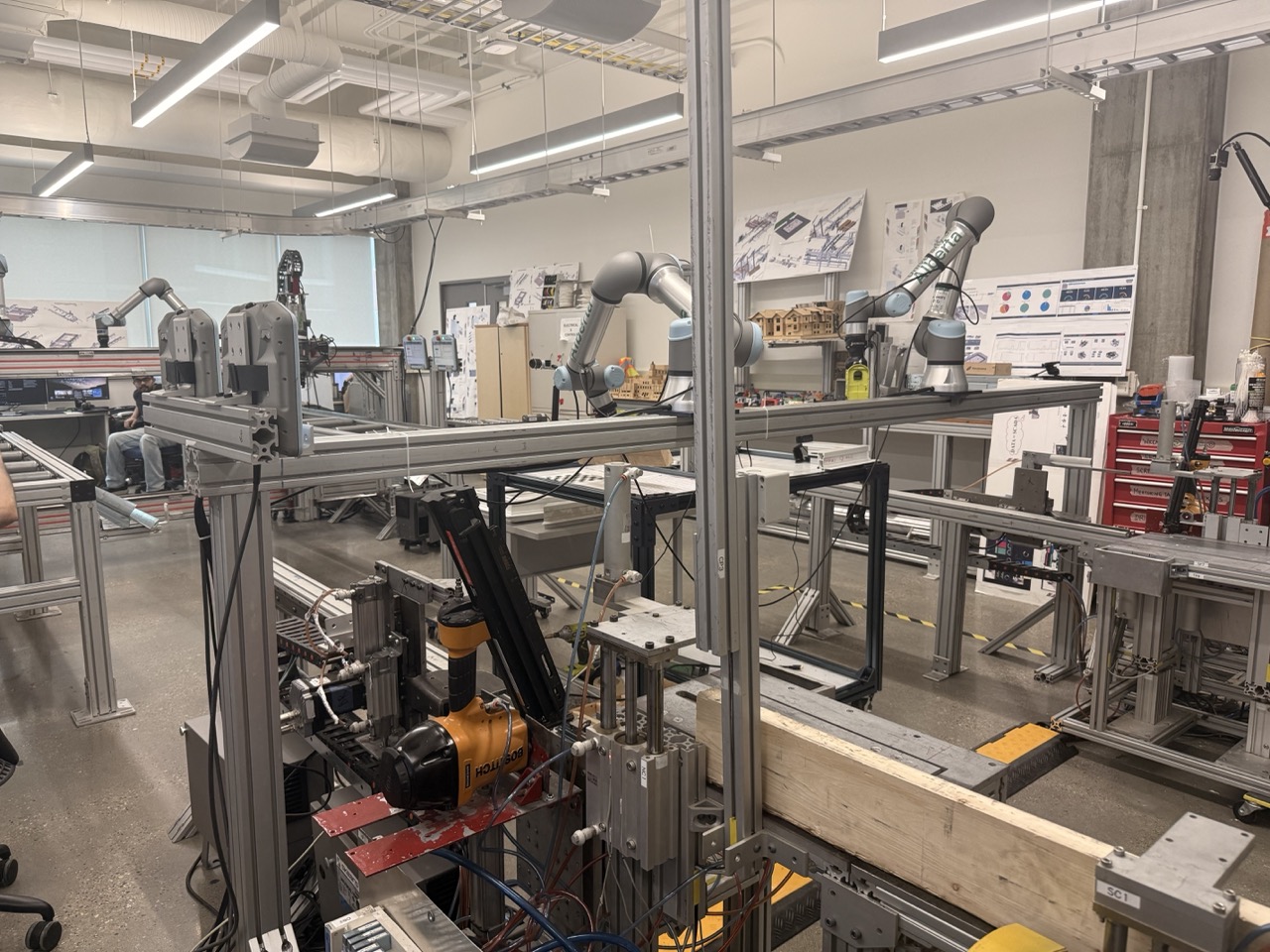
Upstairs, I was introduced to Jamal, who showed me a machine his team built from scratch. It automates the production of wood-frame wall assemblies through three computer-controlled stations: cutting, drilling, and stapling. The control program connects directly to Revit: select a wall in the model, upload it, and the simulation shows exactly how that wall would be produced before any wood is touched. What I did not expect to see: above the conveyor, two UR5 robot arms are now being programmed to take over material handling from the human operator. UR stands for Universal Robots. The same platform I worked alongside the entire summer at LSU. There the robot was printing concrete. Here it is framing walls out of dimensional lumber. Same name on the arm, entirely different application, entirely different philosophy about what building should look like.
The wall assembly machine, with UR5 arms above the conveyor · University of Alberta, July 2026
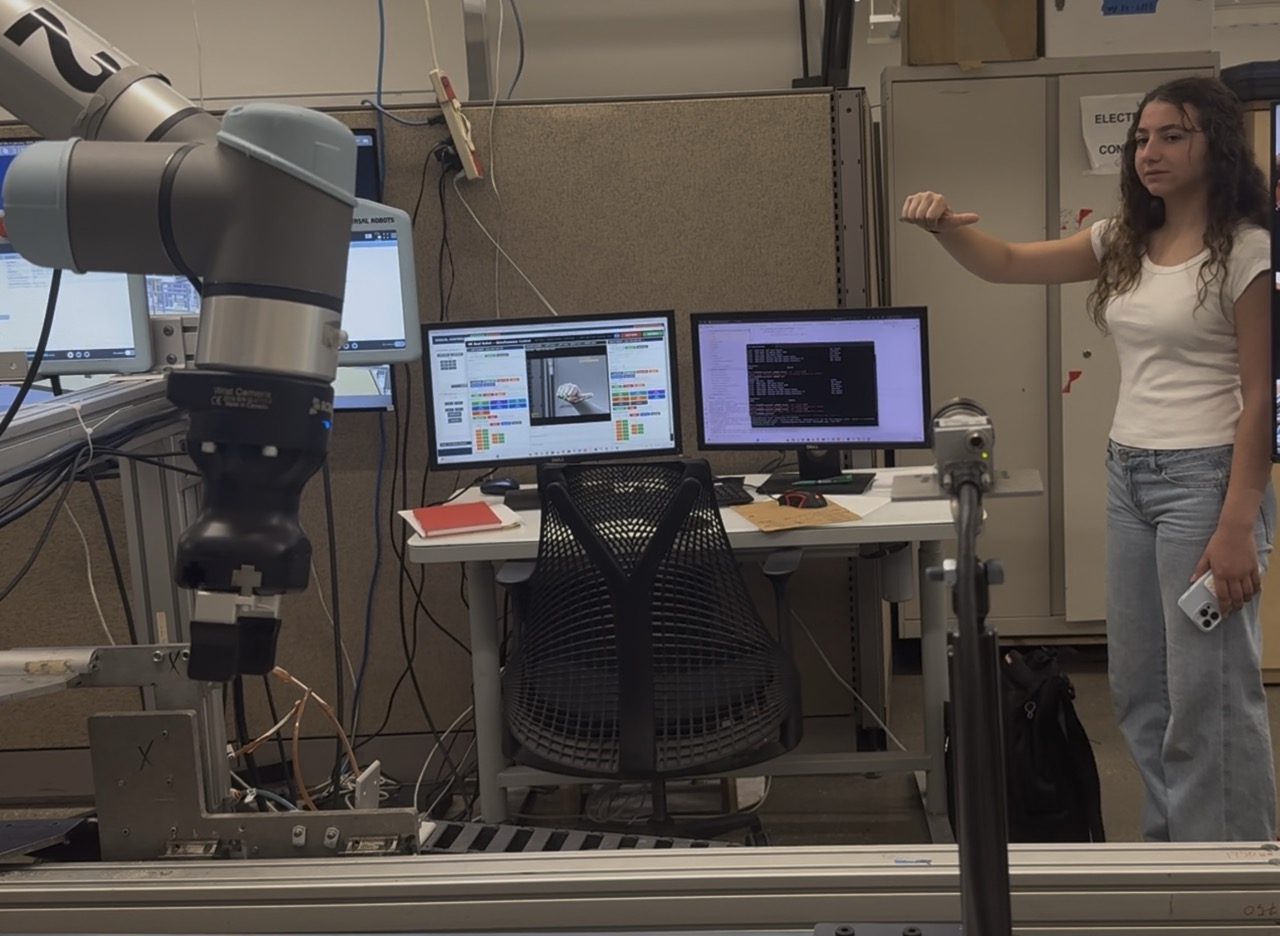
Jamal also demonstrated a gesture-control system for one of the robot arms: thumbs up raises it, thumbs down lowers it, a scissors gesture opens the gripper, a fist closes it. During the demonstration, he let me try the controls myself. I stood in front of the camera and gave the robot a thumbs up and watched it respond. I have thought about that moment more than once since.
Trying the gesture controls during a lab demonstration · University of Alberta, July 2026
Prof. Al-Hussein also introduced me to other members of the group. Sena, a PhD student, researches the human side of the factory: what workers feel and need, and how to support a healthy and productive environment. Jordan works alongside her on job satisfaction among workers in prefabrication facilities. Qusai Al Khaldi researches how architectural elements and interior design can improve quality of life for patients with Alzheimer's disease. In one afternoon I had seen BIM software, robotic automation, industrial human-factors research, and healthcare-adjacent architectural design. The lab is genuinely multidisciplinary in a way I had not fully understood from the outside.
The rest of the week I spent learning. The second day I worked through a full Revit tutorial on my own and then spent the rest of the day building a house model from scratch in the program. Same pattern as my first week at LSU: arrive with zero experience in a piece of software, spend an intense day learning it, have something real to show by the end. The third day I studied civil engineering fundamentals through videos, then worked through an AutoCAD tutorial and built a floor plan. I also made a measurement conversion reference in Google Sheets, which was more practical than it sounds: as an American student working with a Canadian team, the unit differences between imperial and metric come up constantly.
Thursday I learned the different categories of engineering drawings and what needs to be in each for a structure to actually be built correctly. I finalized and exported both my AutoCAD and Revit projects as they would look if prepared for real use. Yasmeen shared her own drawings from a class she took last year, which helped me see where my work stood against near-peer coursework.
I left Edmonton at the end of July. The next phase will be remote collaboration from home, and I will write here when I know more about what that looks like in practice.
What I keep coming back to is how much the two internships now talk to each other. Robotic printing on site at LSU. Industrialized manufacturing offsite at the University of Alberta. Dr. Kazemian's lab and Dr. Al-Hussein's lab are asking the same underlying question by two different routes: how do you make construction better than it has been? I do not think there is one answer. I think the honest answer is probably some version of both. I am grateful I got to see them in the same summer.
July 20–24, 2026Research
LSU week 4: the last day surprised me
Week 4 started with a lab tour. Dr. Kazemian walked me through several other labs in the department, construction management, mechanical engineering, showing me what other graduate students were working on. It was the kind of thing you do not forget. A professor taking time to show you the bigger picture, not just the task in front of you.
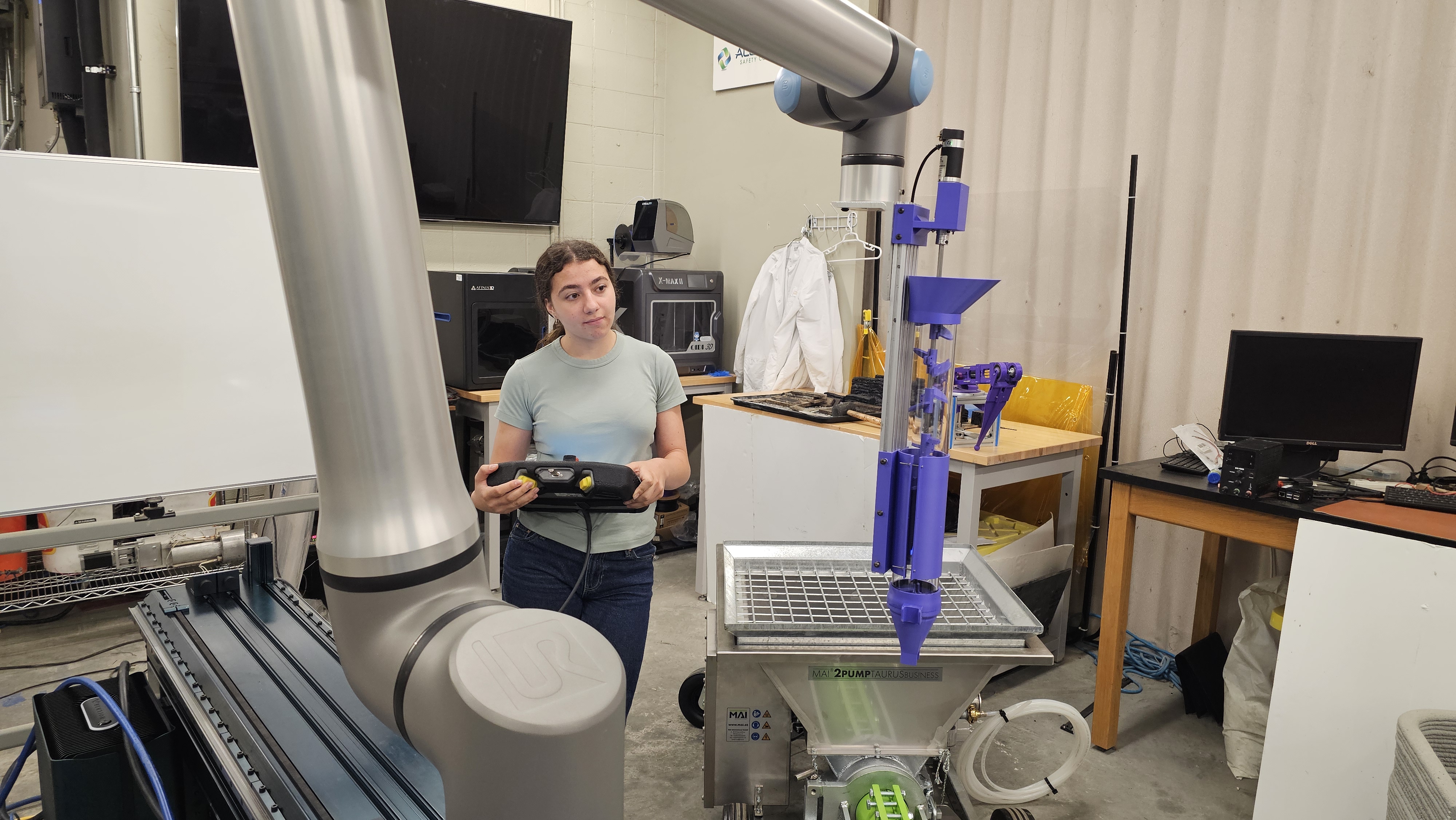
Back in the lab, we had a real deadline. People were coming Tuesday to photograph the lab and the UR20 for a proposal Dr. Kazemian was putting together, which meant the new nozzle we had been building needed to be essentially done by end of day Monday. We finished it. Building it combined things I do not usually do in the same afternoon: 3D printing new parts, cutting a metal plate, gluing pieces, bolting others together. Additive manufacturing, basic machining, adhesive bonding, and mechanical fastening, all in the same build, under a real external deadline.
Operating the robot in the RECAST Lab · LSU, July 2026
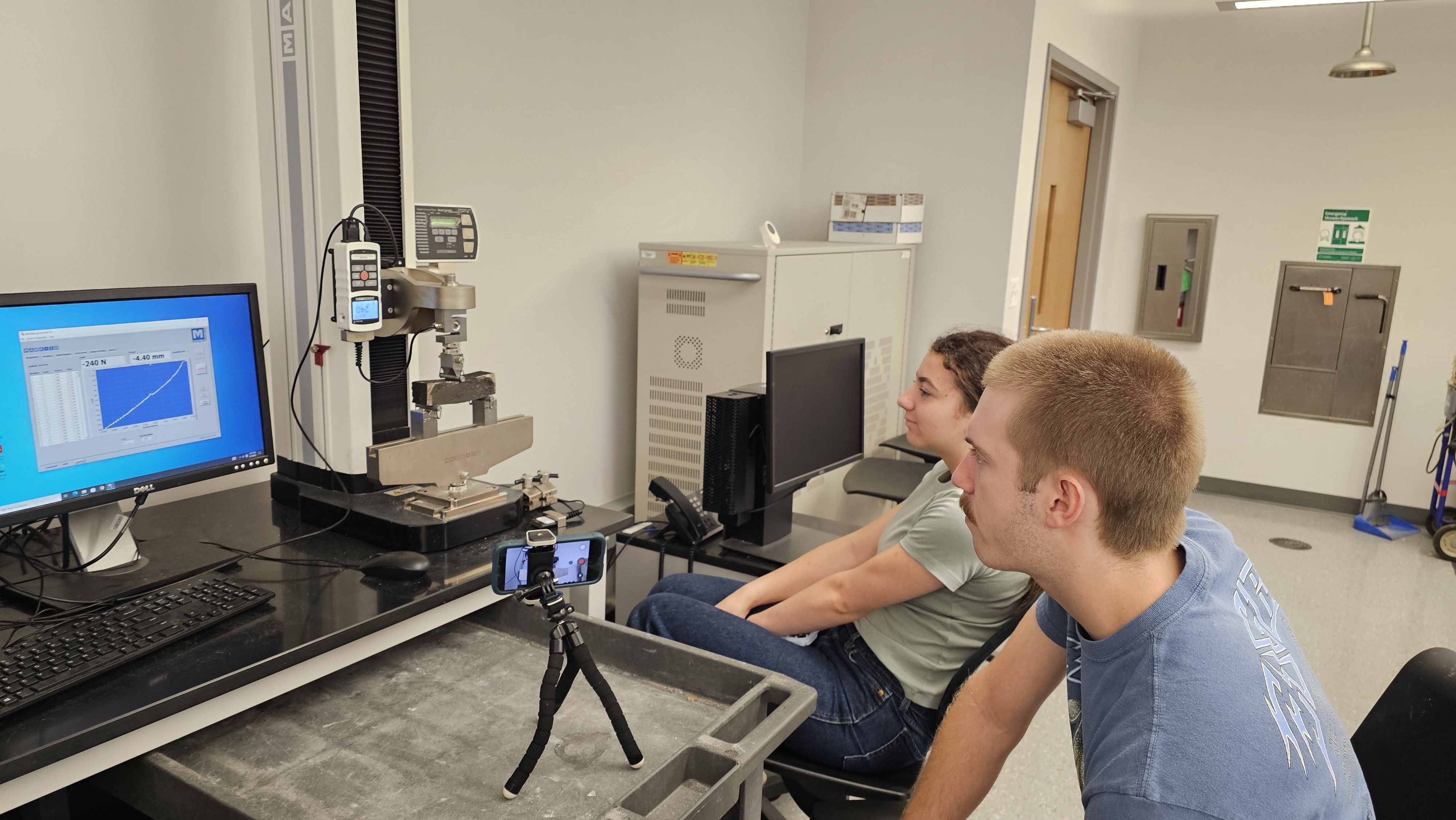
Wednesday was a different kind of day. I ran stress tests on four asphalt blocks using a materials testing machine, measuring how many Newtons of force each could withstand before breaking. I had never used one before. Watching the load curve climb on the screen and waiting for it to peak was quieter than I expected. I also resolved dwell time: the robot now pauses for two seconds at the top of each layer before moving to the next, which gives time to refill the concrete. That goal had been on the list since the end of Week 2.
Dr. Kazemian also looked at two class-project designs I had been working on: an 8-piece sliding puzzle and a scissor lift. He chose the puzzle. He wants more of them printed in LSU's purple and gold. I was not expecting that.
Materials strength testing · LSU, July 2026
Thursday I finally had my first real hands-on time with the UR20, the new robot that had been in the lab since Week 3. Sending the program to it did not work yet, but I was the one setting it up. That will carry over to whenever the lab is ready.
The last day was mostly bug fixes. One: switching between curved and straight wall modes was adding an extra layer. Fixed. Two: the program file was becoming too large to send to the robot past a certain size. We reduced it, but that one is still being worked on. We also installed the sensors on the UR20's linear rail and tested its travel limits.
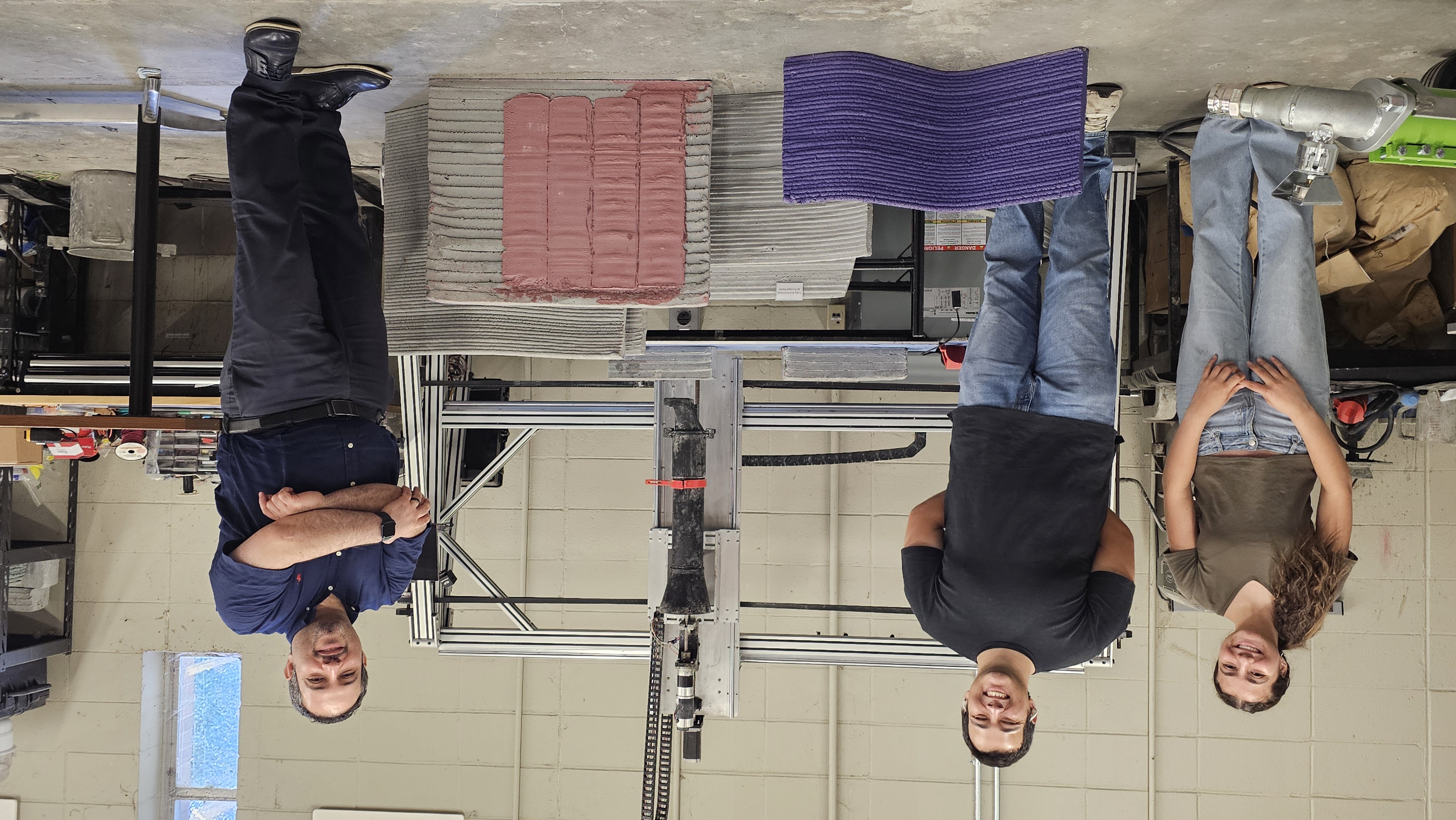
At the end of the day, Dr. Kazemian told me he wants me included in the lab's first published paper about the robot. And that he will feature me on LSU's website.
I genuinely did not know what to say. A published paper. Four weeks ago I did not know what Grasshopper was. I had never programmed a robot. I had never even been to Louisiana. And now the person who made all of this possible is telling me my name will be on the lab's first publication about this work.
I want to say this clearly: I owe this summer to Dr. Kazemian. He did not have to take me. I was a high school junior from New York, out of state, and he had never met me in person before I showed up on Day 1. He let me work alongside his graduate students, trusted me with real problems, personally walked me through other labs, and then ended my last day with news I will probably think about for a long time. I am so grateful.
With Dr. Kazemian and the lab's printed concrete samples · LSU, July 2026
July 13–17, 2026Research
LSU week 3: the UR20 arrives, and we start printing curves
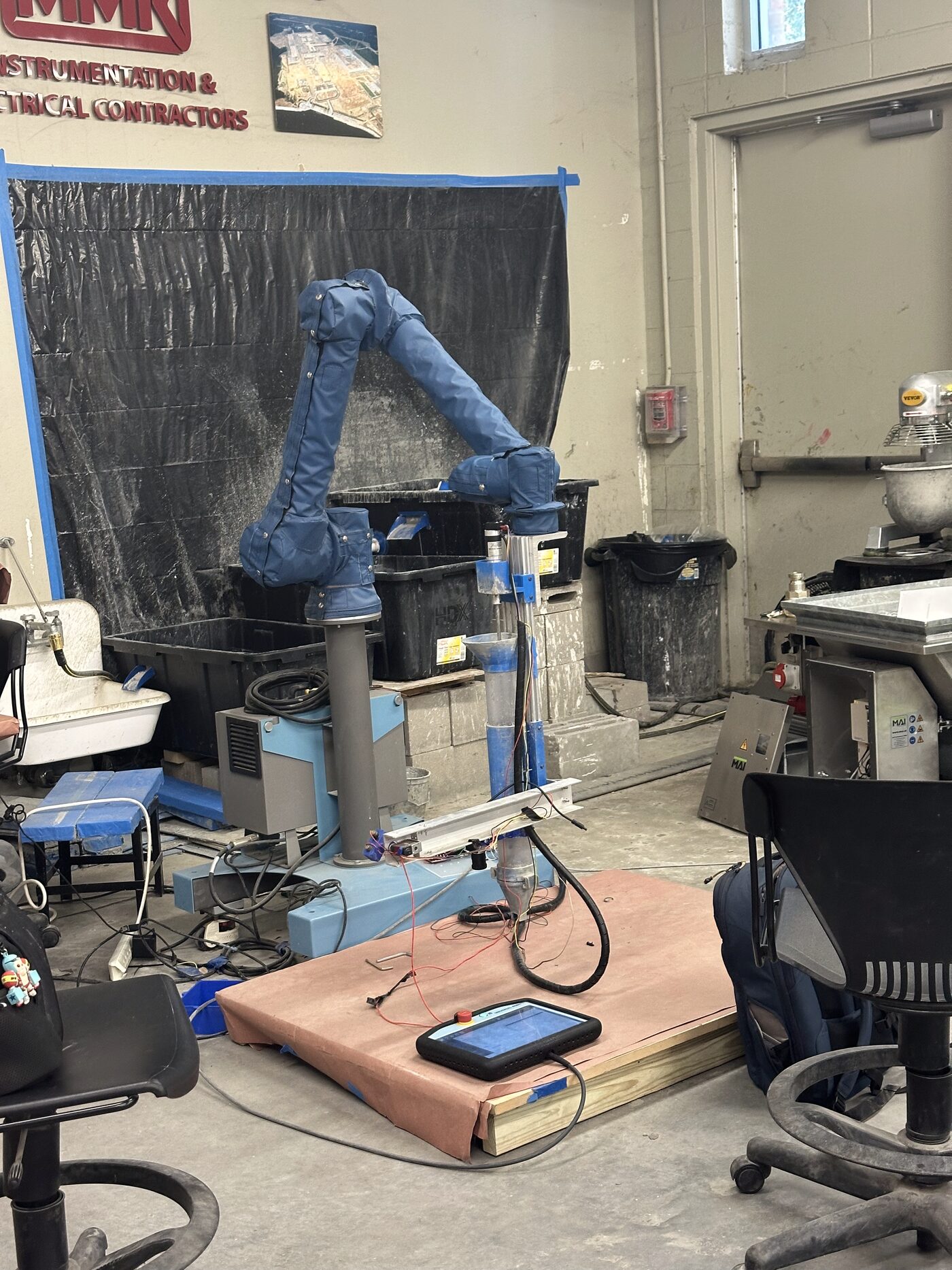
Monday: the UR20 arrived. The new robot is larger than the UR10e we have been working on, and when its 7th-axis linear rail is installed it will be able to slide along a track while printing, which means the lab will be able to build structures far beyond what a fixed-arm robot can reach. Watching the crate come in was exciting. We are not working on it yet, but knowing it is there and that everything we have built on the UR10e will carry over is a good feeling.
We also built a home button this week, a control that stops the print mid-run and sends the robot to a defined safe position. It required writing a separate Grasshopper program that runs alongside the main print sequence and interrupts it on command. Getting two independently-running programs to cooperate took most of the day.
The bigger development was curves. Up to this point everything had been straight walls. This week we figured out how to make the robot print along any curved path, defined parametrically inside Grasshopper rather than drawn in Rhino and imported. I also extended the homing system from Week 2 to work correctly on curved geometry, which required real problem-solving rather than just reusing the existing code.
The nozzle orientation was the hard part. When the robot follows a curve, the nozzle needs to rotate to point in the direction of travel at each point. We figured out how to compute that from the curve's tangent. But because the nozzle is not centered on the robot's tool mount, the rotation was slightly off. We are now running two fixes in parallel: a new custom tool component, and a simpler offset correction. Both still in progress.
Friday was quieter. The UR20 installation was still underway and I could not work on it yet. I spent the day designing and printing a new nozzle for the UR10e, and mapping out the arm's maximum reach so we know the practical size limits of what it can currently build. The nozzle pieces finish printing over the weekend. Week 4 is the last one. I will write an update here when it is done.
The UR10e, the robot I worked on all three weeks · RECAST Lab, July 2026
July 6–11, 2026Research
LSU week 2: we scrapped Fusion 360, and I fixed the bugs
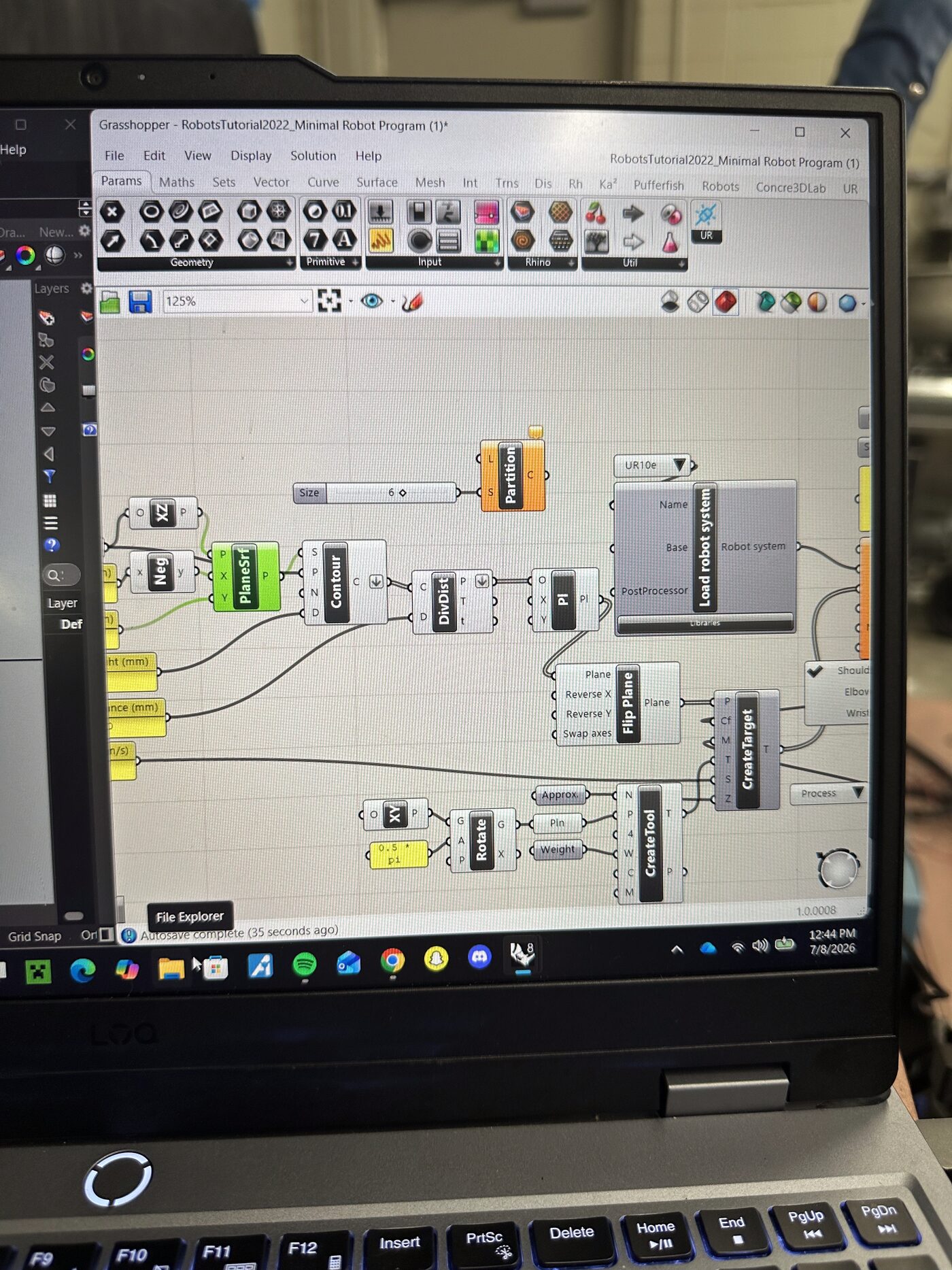
On the first day back after the July 4th weekend, Dr. Kazemian made a call: no more Fusion 360. The lab was moving to an all-Grasshopper pipeline. Everything we had been building needed to be rebuilt from scratch natively in Grasshopper, using a plugin called Pufferfish that none of us, including the grad students, were very familiar with. We worked through it together from the ground up. By end of day most of the pipeline was running again, with one open error about print plane placement carried into Tuesday.
On Tuesday I found the bug. The print plane had been placed in the same physical location as the robot arm itself, which made that position unreachable. Once we moved it, the robot started printing, but it was going left to right instead of right to left. I found a fix for that too, flipping the plane in Grasshopper so the direction corrected. Those two fixes closed out an error that had been sitting open since Day 3 of the internship, when the robot first moved the wrong way.
The rest of the week was about making the system more robust. We added homing points so the robot returns to a defined position after each layer. Then we made the homing system parametric, so it works for any wall width and height, not just the fixed case we had tested. On Friday I worked alone because my usual grad student partner was out. I closed the homing-per-layer bug that had been open since Wednesday, added a pause and play button, and solved a harder problem that other grad students on the team gave me: figuring out how to change the robot's print speed mid-print. Three things in one day, on my own.
I was glad to have written the manual the week before. I referenced it more than once while working alone.
The all-Grasshopper pipeline, with Pufferfish and the UR10e robot definition loaded · RECAST Lab, July 8, 2026
June 29 – July 4, 2026Research
LSU week 1: concrete, robots, and writing a manual from scratch
I want to say this clearly before anything else: I owe this entire summer to Dr. Ali Kazemian. I had only ever spoken to him once, on a Zoom call. I am a high school junior from New York. I had never been to Baton Rouge, I had never met him in person, and I am years younger than everyone else in his lab. He said yes anyway, welcomed me in, and put me to work alongside his graduate students from the very first day. I am genuinely grateful for that.
The RECAST Lab at LSU does something I had not fully pictured until I walked in: they 3D-print buildings. Not models or prototypes but load-bearing concrete wall structures, using an industrial robotic arm. There is also a sulfur printer, which works with different material properties for a different set of research questions. The first day was orientation: a Raspberry Pi course, introductions to both printers, and time looking at wall segments the lab had already printed. They are bigger than I expected.
Day two introduced me to Grasshopper, the parametric design software that drives the robot's toolpaths. I had never used it before. By end of day I had a rough sense of how a Grasshopper model connects to robot programming and ultimately to the printer itself.
By Thursday, I had written a technical manual. I called it the Grasshopper Code Manual. It documents the full pipeline the lab uses: loading the robot definition, defining a path, generating the robot program, simulating the motion, and uploading it directly to the physical arm, all with screenshots. Dr. Kazemian shared it with the team. Going from zero Grasshopper experience on Monday to a step-by-step manual by Thursday was not something I planned, but the documentation felt necessary and I had enough to write it.
I also started designing a mini house in Fusion 360 for Prof. Kazemian's undergraduate construction class. My idea was to print the walls, floor, and roof as separate pieces so students can assemble it themselves. And somewhere in the middle of all of it, Dr. Kazemian mentioned that Walmart has had store expansions built with robotic concrete 3D printing. We looked it up together. A company called Alquist 3D has already built more than a dozen commercial structures this way, printing walls 16 feet tall in under 75 hours. That was the moment the scale of what this technology actually is clicked for me.
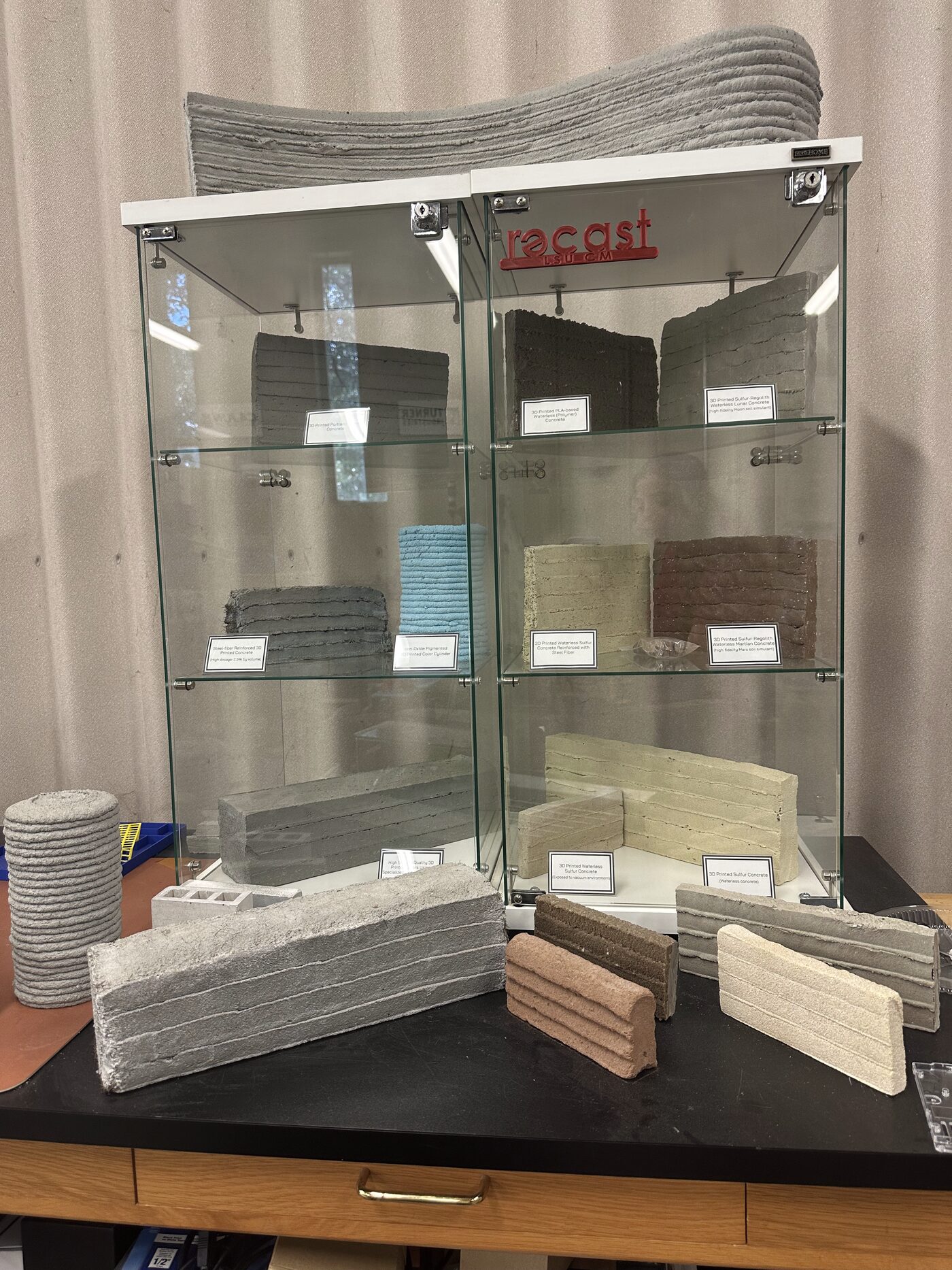
Printed concrete and sulfur samples in the RECAST Lab display · LSU, June 2026
June 2026News
I might be in a documentary
Last summer, during my internship at Free3DHands, a film crew came to visit. They were there to document the work of Mat Bowtell, who has spent years using 3D printing to build prosthetics for people who need them. The project they were filming was a documentary called The Last Inventor: Chuck Hull, 3D Printing and Hope.
Chuck Hull is the man who invented stereolithography on the night of November 10, 1983, in a lab in San Gabriel, California. That is the technology all modern 3D printing is built on. Without that night in that lab, none of what I do would look the way it does.
He was there at Free3DHands that day. I got to meet him. I was also asked if I would be willing to be interviewed for the film. I said yes, and tried to say something coherent on camera about why this work matters to me. Whether any of it was useful to them, I genuinely had no idea. I spent most of the following months assuming I had ended up on the cutting room floor.
Then in December 2025, I came across an article in the Santa Clarita Valley Signal written by journalist Habeba Mostafa, about Anntionette Hull, Chuck's wife and the film's producer. I wrote to Habeba in May to ask if she had any update on the release, and quietly, whether I was still in it.
She was kind enough to follow up with Anntionette directly. A few days later I had an invitation to the world premiere.
The premiere is on November 10, 2026, the 43rd anniversary of the night Chuck cracked the code. It is being held at the American Legion Hall Post 43 in Hollywood. There is a media event in the morning, a meet and greet in the afternoon, and the screening at 6:30 in the evening, followed by a book signing. Anntionette is also releasing a book under the same title.
I am still a little stunned. I will update here after November.
May 19, 2026News
I was elected senior class president
I woke up on May 19th knowing it was election day. I had known for weeks that I was running, and I had done what I could to prepare, but the morning of felt different from the weeks before it.
At school, homeroom ran longer than usual. The administration gave everyone extra time to vote, so the whole day started with that fact sitting in the room. I went to my classes and tried to be present in them. I was not entirely successful at that.
At four in the afternoon, the assistant principal sent an email to everyone who had been running. That was how we found out, before the rest of the school. The full results went out to everyone the next morning.
I am still a little surprised, honestly. I ran because I care about making our last year together something worth remembering, and because I wanted to be one of the people responsible for getting that right.
The job comes with a list of things to plan: chalking the entrance to the school, prom, and a handful of other senior traditions. I am looking forward to all of it.
The part I think about most is the commencement speech. I will be speaking on behalf of our class at graduation, in front of everyone, and I want to get it right. I have been writing down thoughts and trying to figure out what I actually want to say on that day. I do not know yet. But I am working on it.
May 19, 2026News
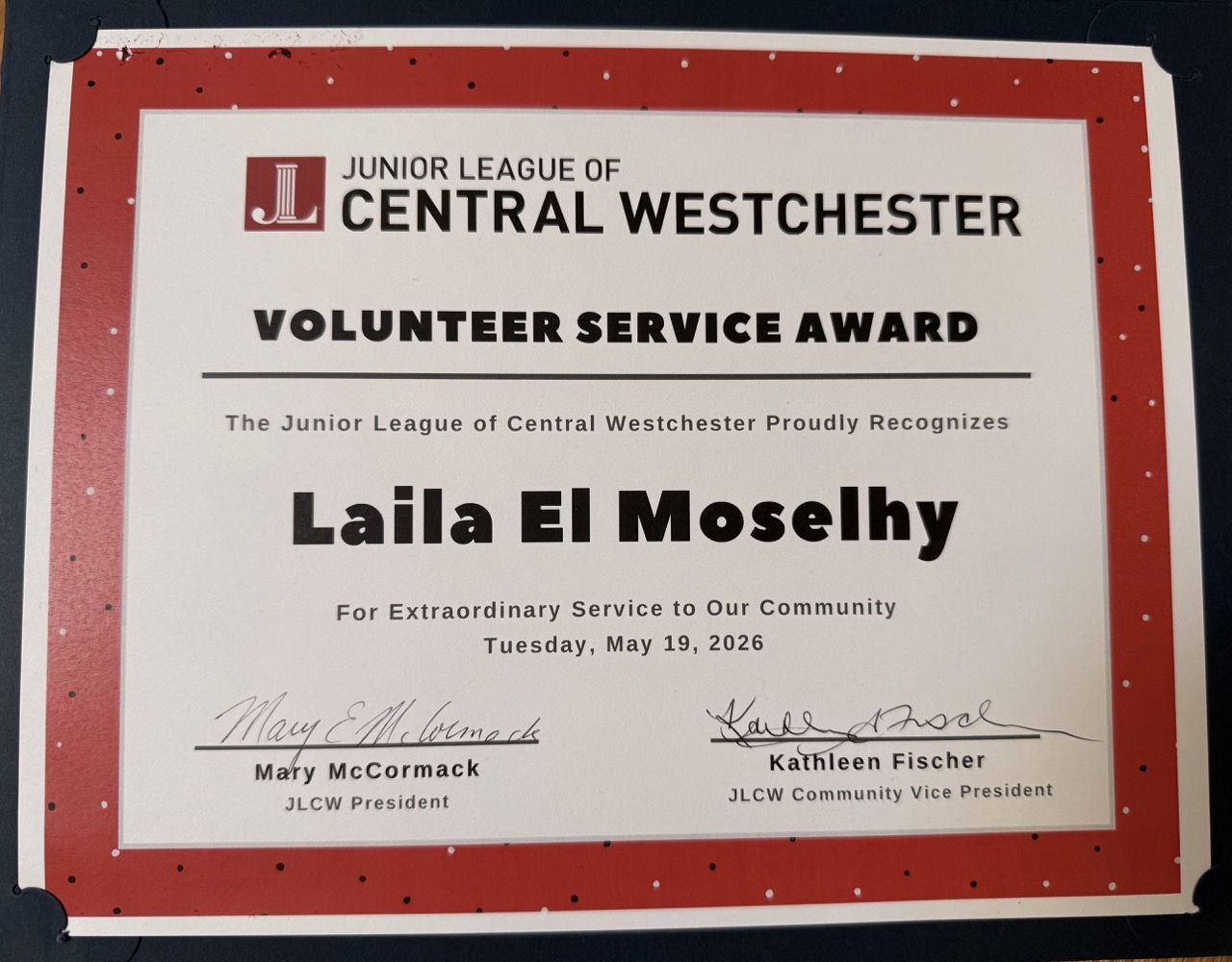
Junior League of Central Westchester Volunteer Service Award
May 19th turned out to be more than one thing. I wrote separately about finding out I was elected senior class president that afternoon. But I also want to write about this.
The Junior League of Central Westchester is a women's organization with a long history of community service in this area. Each year, they select up to four female high school juniors from across Central and Northern Westchester to receive their Volunteer Service Award, recognizing young women who have demonstrated a sustained commitment to volunteerism and public service over at least three years. I was one of this year's honorable mentions.
Junior League of Central Westchester Volunteer Service Award · May 19, 2026
Thank you to the Junior League of Central Westchester. And to everyone who has been part of this work from the beginning: the e-NABLE community, the families who trusted me with their children's cases, and everyone who has donated or helped keep things running. The award has my name on it, but it belongs to all of them.
May 12, 2026Research
I spoke at the Village Board about stormwater
I live on Brite Avenue. When Hurricane Ida hit in 2021, I watched cars stall in the road outside our house. Neighbors who had never flooded before were pulling things out of their basements. I was twelve. I did not know much about stormwater infrastructure then, and I did not think to ask why it happened. This spring, I started asking.
I have always been interested in civil engineering, and this spring I decided to explore it in a more concrete way. I reached out to the Scarsdale Village Engineering Department, and Village Engineer Dave Goessl agreed to meet with me. We talked for about an hour. He walked me through the infrastructure challenges the Village is managing, and stormwater kept coming up: aging pipes and culverts that were never designed for the kinds of storms we are having more often now. I recognized what he was describing. I had watched it from my front yard.
Over the following months I worked through about a dozen sources: the Sheldrake River Flood Mitigation Study, the Brite Avenue Drainage Improvements Report, state grant documentation, NYC DEP green infrastructure reports, and ongoing coverage in Scarsdale10583. I was looking for something specific, and eventually I found it.
The Sheldrake flood-mitigation project and the Scarsdale Middle School field rebuild were happening at the same site on a similar timeline. The plans were focused on gray infrastructure: pipes, culverts, a retention basin. That work is necessary. But the site also looked like a candidate for green stormwater infrastructure at the same time, bioswales, permeable pavement, bioretention features that slow runoff before it reaches the pipes. New York State has a grant program, the EFC Green Resiliency Grant, that funds up to ninety percent of a project's cost, up to ten million dollars. The next cycle was opening soon. It seemed like a moment worth raising at the Village Board.
On May 12, I gave a 3.5-minute public comment. I had written it out and practiced it, but there is a difference between saying something at home and saying it in front of a board of trustees and a room of adults who have been living in this town for decades longer than I have. I said what I had found and sat down.
Mayor Justin Arest thanked me and asked that I submit my comments in writing to the full Board so staff could review the material. Trustee Tim Foley, Chair of the Village's Infrastructure Committee, responded at the meeting:
"You are right, this is a trend among communities to see how they can improve stormwater infrastructure while making repairs. I saw a similar project in Hoboken. You are definitely ahead of the curve."
The next day, both the Mayor and Trustee Foley wrote to me by email. Mayor Arest said my comment was "substantive and well-researched" and that the Green Resiliency Grant was "exactly the kind of funding opportunity worth exploring." Trustee Foley shared that he had moderated a panel on municipal stormwater funding about a month earlier, and that his committee was planning public meetings on integrated approaches this year. He offered to keep me in the loop.
Scarsdale10583 covered the meeting and printed my full comment. The headline used the phrase "A Call for Green Infrastructure." You can also watch the full meeting recording — I speak at 4:45.
I am extending this into a science research project through senior year. I did not expect a public comment to become something ongoing. But it did, and I want to see where it goes.
May 2026Cases
His robot Chase hand
The hands arrived in Strand on March 5. Chantel messaged the same day. Noah had already tried both on and was excited. The 65% fit well. The 55% was a little small.
In the weeks after, she started making small adjustments without asking me. First she added a strip of foam inside the socket where the plastic was pressing on his skin. That was all it took. He wore it to school two days in a row, and his teacher noticed he was using it more.
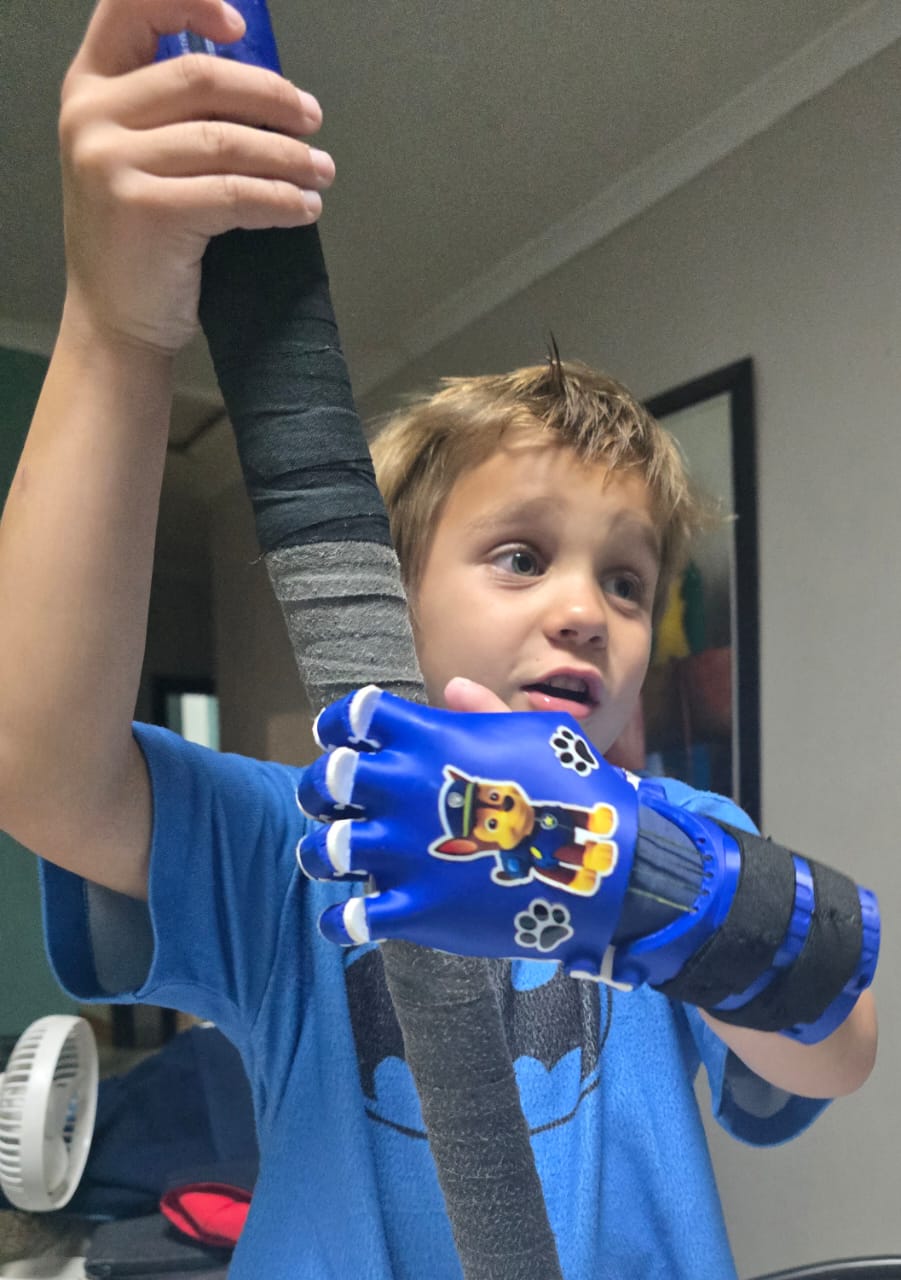
Then she replaced the velcro straps with soft elastic she bought herself and sewed on by hand. Now Noah can put the hand on and off without any help. He does it himself. That matters a lot to a four-year-old.
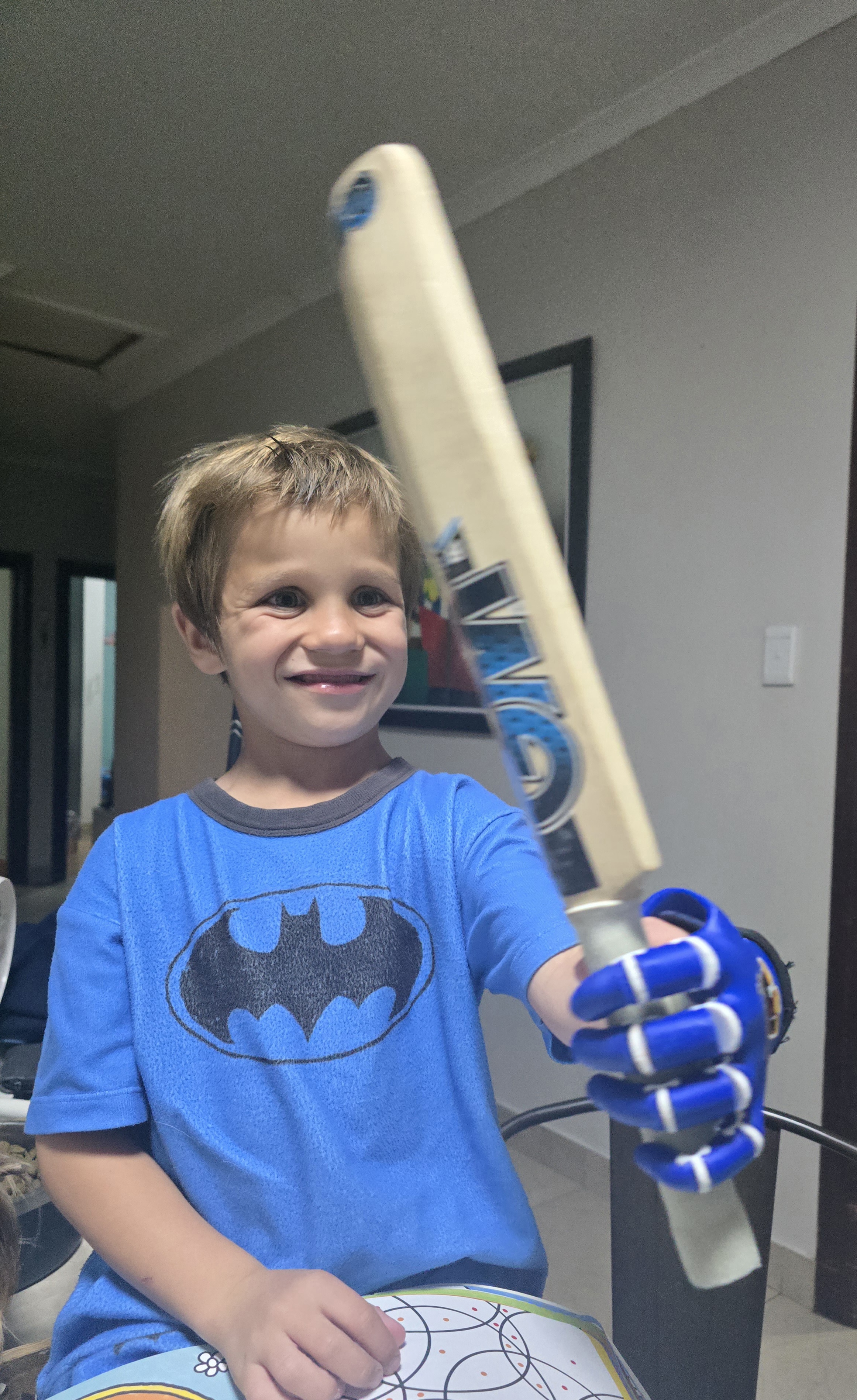
He also covered it in Paw Patrol stickers. Chase is his favorite, so as far as Noah is concerned, the dark blue hand is now officially his robot Chase hand. Chantel says he shows it to everyone. His friends, his teacher, anyone who will look.
Then she sent the cricket bat photos. Noah in a blue Batman shirt, holding the bat with his prosthetic hand, grinning like he has no intention of putting it down. I did not design the hand with cricket in mind but there it is, doing the job.
One more thing I did not expect: a prosthetist in the Western Cape found Noah's case online and reached out asking for the design files so he can print more hands locally for children in South Africa. I sent them the same day.
I found O.'s case while browsing old e-NABLE requests that had never been fulfilled. She was four years old, in Abuja, Nigeria, born with a right limb difference below the elbow. Her case had been sitting on the hub since December 2024. Her father Phil had submitted measurements and photos and waited. No volunteer had taken it.
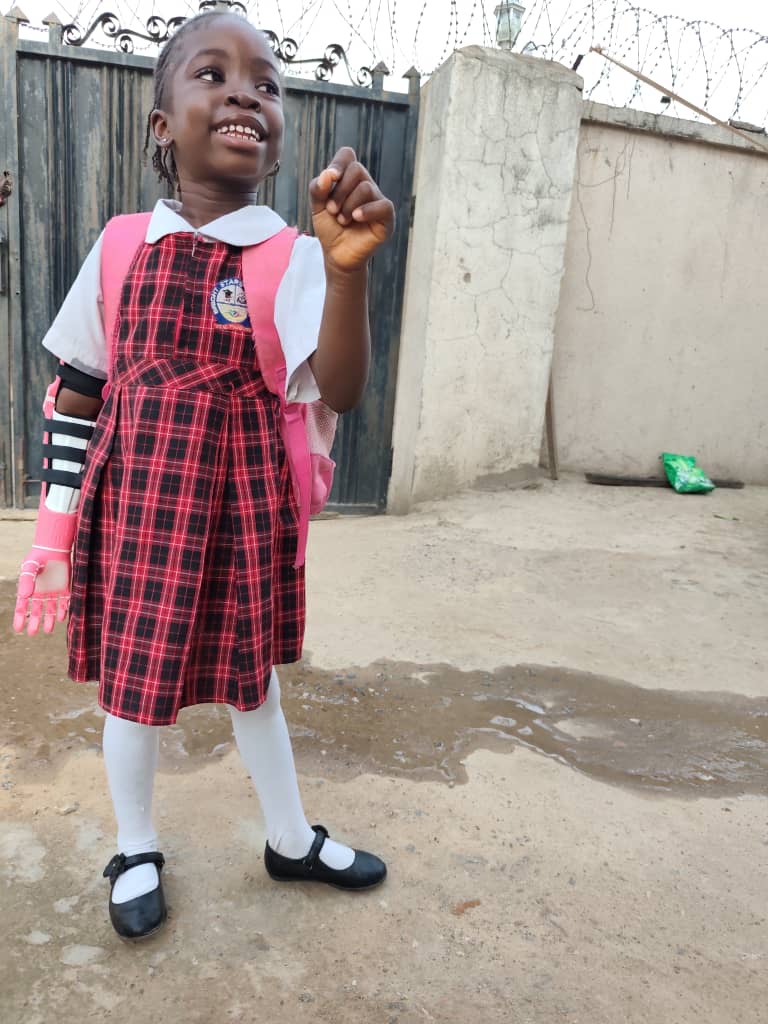
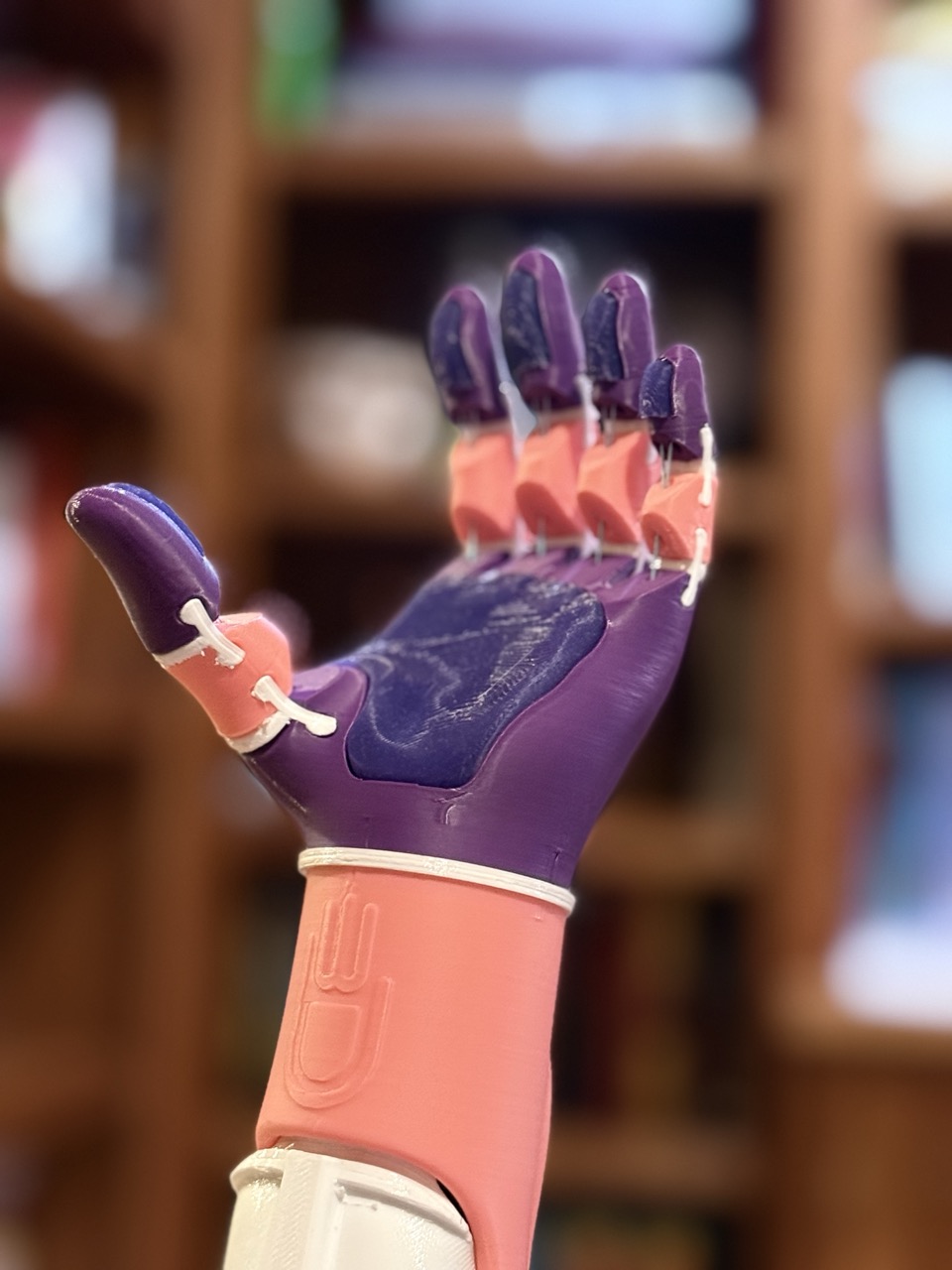
I reached out. Phil replied the same day. He said she loves pink. I made her a pink Kinetic Arm at 57.5% scale, sized for a young child. Phil had mentioned a slight curve at the tip of her residual limb, so I printed a second arm too, purple and yellow, with a modified inner cover that had a cutout to accommodate the curve. I wanted to make sure at least one of them would fit. I shipped both to Abuja on February 19.
The arms arrived on April 15. The e-NABLE website had been down for weeks, so Phil had no way to reach me. I reached out through the phone number he had shared for the shipment. He wrote back the same night: "Yes, we received it on the 15th of April and it's lovely. Olanna has tried both and they fit so well."
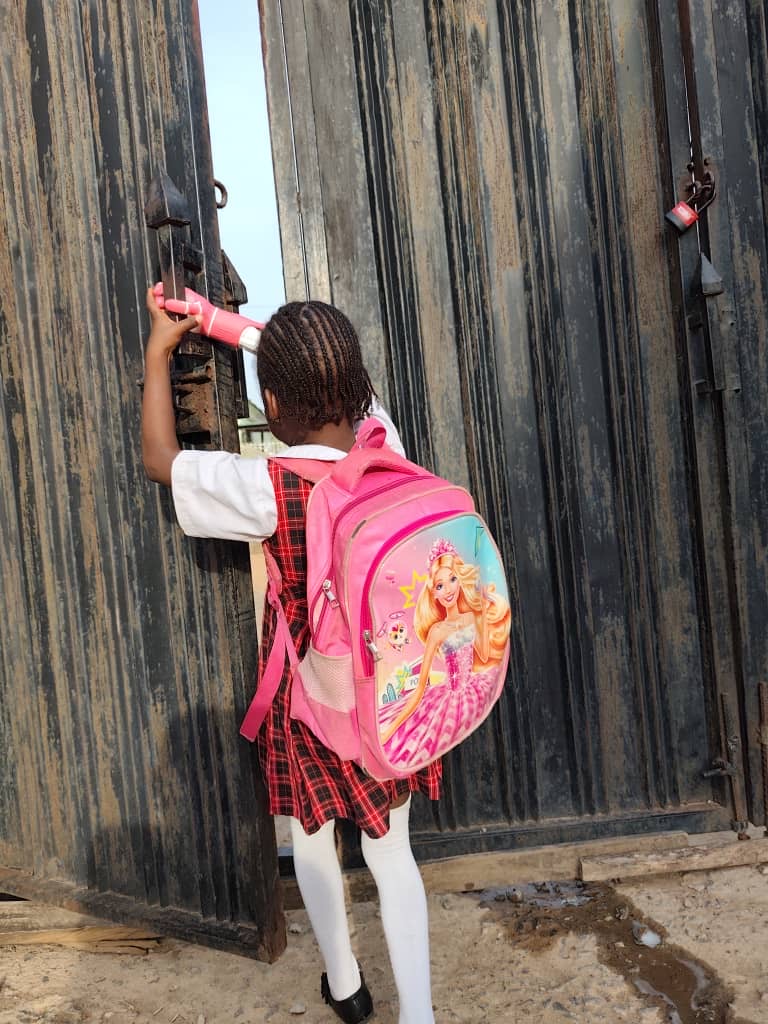
Then he sent photos. O. in her school uniform, Barbie backpack on, using her pink arm to push open the school gate on her way in. I was not expecting that. I still think about it.
O.C. on her way to school, Abuja · April 2026
Using her arm to open the school gate
Phil also sent a message that I keep coming back to: "Thank you Laila. I am speechless. Olanna is filled with joy."
On Monday, April 6, I got a message from Luai, the coordinator in the West Bank who helped me get S.'s arm to her. He sent me a video. She was trying it on for the first time.
In the video, Luai says she has had it for only fifteen minutes. You can already see her figuring it out, adjusting, trying again. Fifteen minutes in and she is already getting better. I have been working on her case for a long time, and to see that moment was something I am still not sure how to put into words.
Luai also shared that her family is very grateful and are praying for me. I did not expect that. I am just a teenager in New York with a 3D printer. The fact that a family in the West Bank is thinking of me is something I will carry for a long time.
They also made a TikTok about it, which you can watch below. The full YouTube video is on S.'s case page if you want to follow her story from the beginning.
S. holding up her arm for the first time · West Bank, April 2026
Presenting my volunteer work to the global e-NABLE community
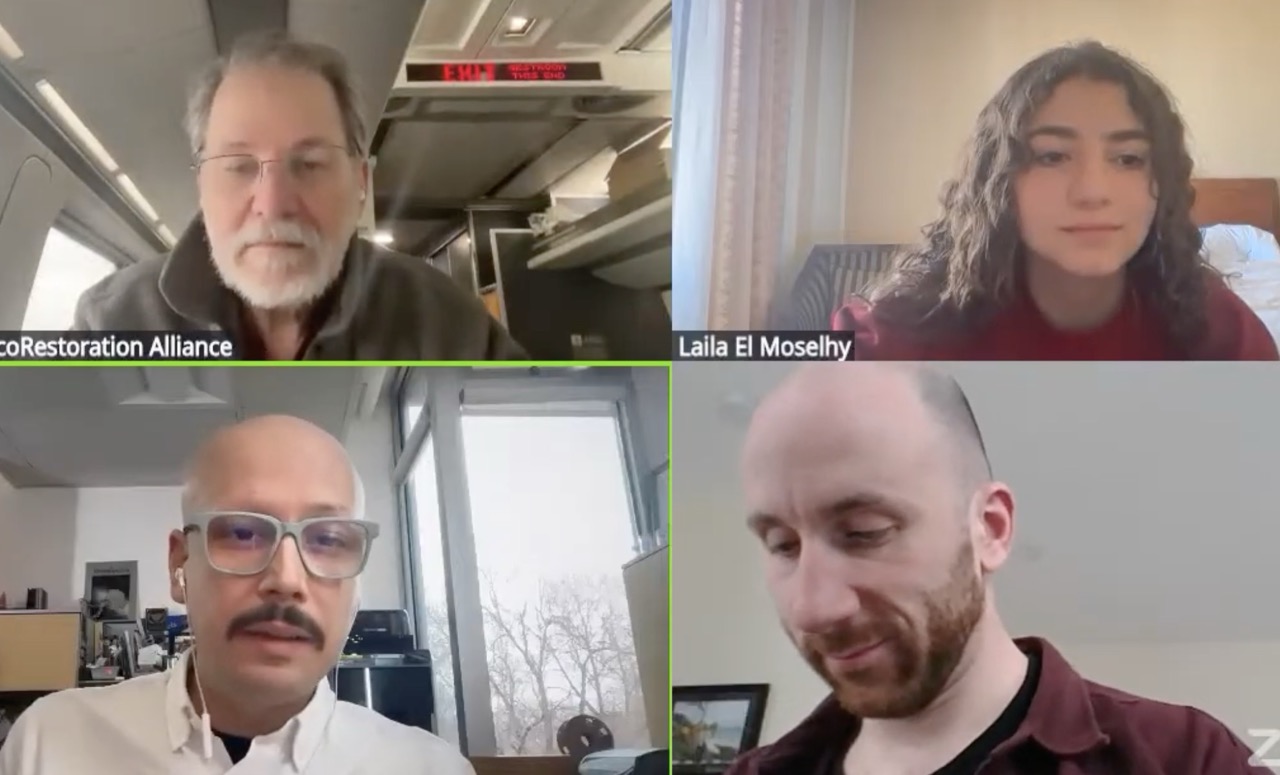
On April 2, I was invited to present at the e-NABLE Education and New Members meeting, led by Prof. Ian Roy from Brandeis University, and joined by Mr. Jon Schull, the co-founder of e-NABLE. I had no idea what to expect. I just wanted to share what I had learned in a way that might be useful to someone starting out.
I walked through my whole journey: how it started with just printing hands from the e-NABLE website, my first real case in the Philippines, the design challenges I ran into with Manahil in Pakistan, my internship at Hand in Hand in Egypt, meeting Mr. Mat Bowtell at Free 3D Hands in Australia, the cases in Romania, Nevada, China, Uganda, Palestine and more. I also talked about how I find cases on the hub, the materials I have tried, and the independent study I am doing on bionic arms at school now.
It was the first time I had sat down and looked at two years of work all at once. A lot has happened.
The meeting on Zoom, April 2, 2026
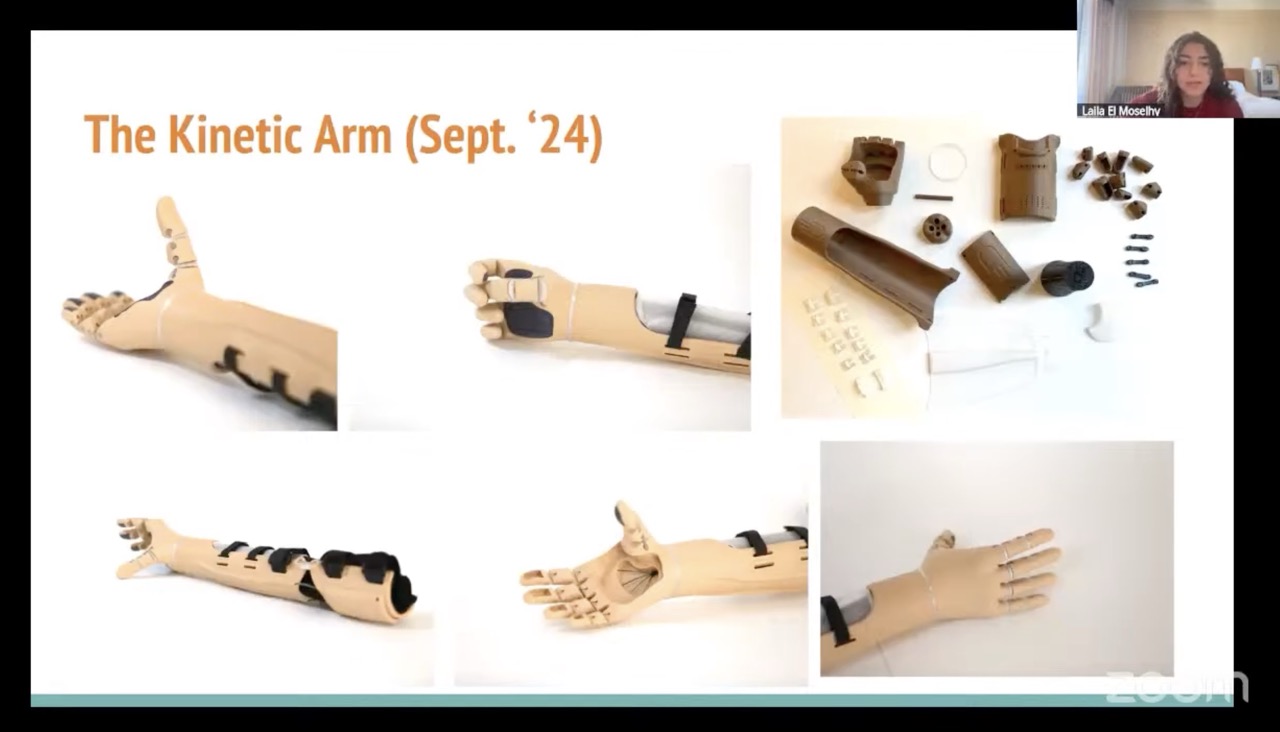
Presenting the Kinetic Arm slide
The full recording is on YouTube if you want to watch it:
Full recording · e-NABLE Education and New Members · April 2, 2026
The feedback from the group was something I did not expect. Mr. Jon Schull invited me to join the monthly town hall as a regular contributor, which I am genuinely considering. Mr. David, who has been an e-NABLE volunteer for over 10 years and worked as a mechanical engineer in medical devices and surgical robotics, said some things that really stayed with me.
"I've been with e-NABLE for about 10 years and I've had fewer successful recipients than you have."
Mr. David, e-NABLE volunteer and medical device engineer
"You have managed to understand and do everything we have been trying to make possible. You are sort of the personification of what we are aiming for."
Mr. Jon Schull, co-founder of e-NABLE
I am still processing all of it honestly. I came in just wanting to share what I had learned, and I left with people offering to help me with CAD, materials, equipment, and more. That is what this community is. I am so grateful it exists. It started everything for me.
Spring 2026Independent Study
Building a bionic arm as an independent study at Scarsdale High School
As part of an independent study this semester, I am designing and building a bionic arm, one that uses electromyography sensors to detect muscle signals and translate them into movement. It is a significant step up from the Kinetic Arms I build through e-NABLE, which are body-powered and require no electronics. This project is pushing me into territory I have never worked in before: circuits, signal processing, and motor control alongside the printing and assembly I already know.
The design I am building is the El Medallo Bionic Arm, created at eNABLE Medellin by a team of designers: Mark Walbran, Oliver Vogel, Ben Complin, Esteban Rojas, Mohit Mothukuri, Elena Guss, and Bryn Davis. It is described as the world's cheapest-to-fabricate open source bionic prosthetic, which is part of why it made sense for this project. The mechanical design is a variant of the Kwawu Arm by Jacquin Buchanan.
What makes it genuinely interesting from an engineering standpoint is the grip system. The arm has two distinct grips: a pinch grip and a power grip, each triggered by a different muscle contraction picked up by the EMG sensors. Two servo motors control the fingers, and the timing of each motor is what produces the different grip types. The estimated build time is around 80 hours from start to finish, including sourcing parts, soldering, calibrating the sensors, and assembly. That does not count any time needed to customize the fit for a specific person.
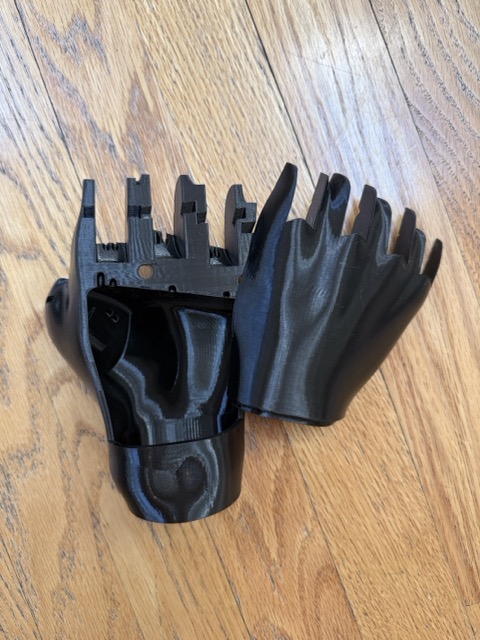
What immediately struck me about it compared to everything I have printed before is the palm. In a standard Kinetic Arm the hand is mostly solid. Here, the palm is hollow, with a separate cover that fits over it. That cavity is where all the wiring, sensors, and electronics will live. It is a completely different way of thinking about the structure of a hand. I am printing in black and silver PETG. The palm is the first major component off the printer, and seeing it in person made the whole project feel much more real.
The printed palm and its cover. The hollow chamber is where all the wiring and EMG sensors will sit.